
Seven ways to be heard at your next condo or HOA meeting

Residents are encouraged to attend and observe community association board meetings. If you’d like to bring an issue to your community association governing board’s attention, you’re welcome to speak during the homeowner forum—a time set aside just for you.

So that everyone who attends has an opportunity for a meaningful exchange with the board, typically residents are asked to observe the following guidelines:

Act professionally. Although you’re all neighbors, this is a corporate business meeting. Please behave accordingly.

Sign in. If you’d like to address the board, please sign in when you arrive. You will be called in the order you entered. This allows the board to contact you if further information is needed and to report back to you with an answer.

Be productive. The homeowner forum is an exchange of ideas, not a gripe session. If you’re bringing a problem to the board’s attention, share your ideas for a solution too.

Leave emotions aside. To keep the meeting businesslike, please refrain from speaking if you’re particularly upset about an issue. Consider speaking later, speaking privately with a board member, or putting your concerns in writing and emailing them to the board.

Take your turn. Only one person may speak at a time. Please respect others’ opinions by remaining silent when someone else has the floor.
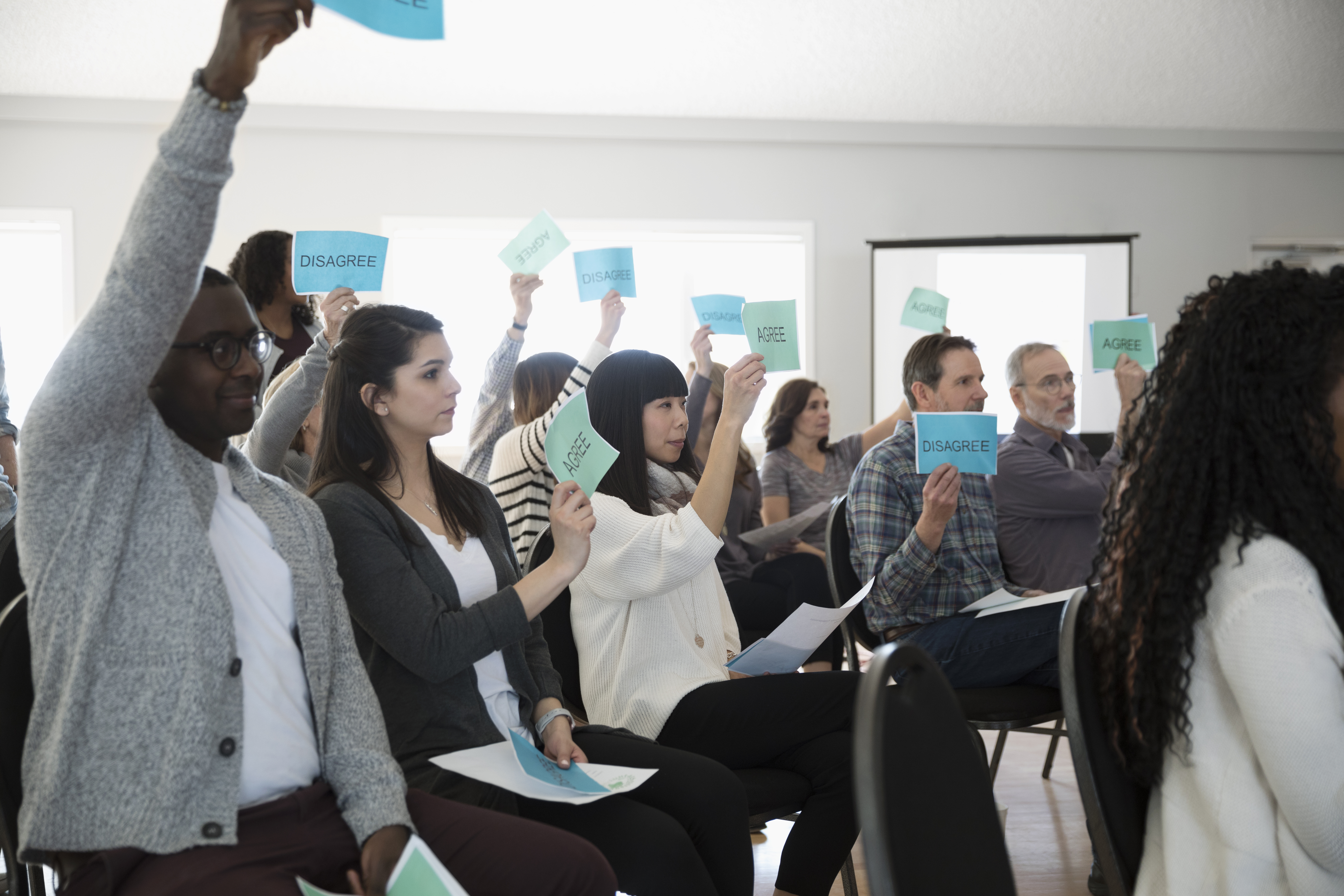
Keep it brief. Each person will be allowed to speak no more than five minutes. Please respect the volunteers’ time by limiting your remarks. If you need more than five minutes, please put your comments in writing. Include background information, causes, circumstances, desired solutions, and other considerations you believe are important. The board will make your written summary an agenda item at the next meeting.

The board may not be able to solve your concerns on the spot, and it’s not a good practice to argue or debate an issue with you during the homeowner forum. The board usually needs to discuss and vote on the issue first. But every good board should answer you before—or at—the next board meeting.

For more information about managing your community association’s homeowner forum, find the latest on-demand webinars and publications on community association governance.

Don’t miss out on valuable information like this from CAI. Subscribe and receive CAI’s Ungated blog directly to your inbox. Check the subscription box at the right on your screen.

The post Seven ways to be heard at your next condo or HOA meeting appeared first on Ungated: Community Associations Institute Blog.

BiggerPockets Podcast 314: How to Find Rockstar Contractors and Manage Like a Boss with Andresa Guidelli

Would your real estate business benefit from better rehab/construction knowledge or tactics? Well, that’s the focus of today’s show, where Andresa shares her story of moving from Brazil to America and crushing it in the real estate space!

Andresa excels in an area many of us find extremely challenging: managing rehabs. In this episode, she pulls back the curtain and shares tips for how you can do the same. Andresa gives great advice for finding excellent contractors (and vetting them), the three things she puts in every contract, and how she makes sure she’s never ripped off.

You won’t want to miss her advice on finding the perfect team, determining the scope of work for your project, and learning your market. Andresa also shares a killer tip about challenging low appraisals she’s used successfully three separate times! Andresa is able to skillfully manage several rehab projects at a time while also running a side Airbnb business and gives great guidance on how you can do the same. Download this one now!

A ‘kinder, gentler’ community starts with you

“Where is it written that we must act as if we do not care, as if we’re not moved? Well, I am moved. I want a kinder, gentler nation.”

That was the late George H.W. Bush as he accepted the Republican nomination for president in 1988. Bush, of course, would go on to serve in the Oval Office from 1989–1993. His call for civility rang true then and rings true today, perhaps even more so. It applies in politics, society in general, and in community associations.

Many association board members, managers, and business partners report dealing with disruptions at meetings, profane and threatening emails, and other behavior that most people would consider uncivil. In fact, some communities are moving to adopt codes that demand courteousness and respect, ban foul language, and prohibit threats of physical and psychological harm.

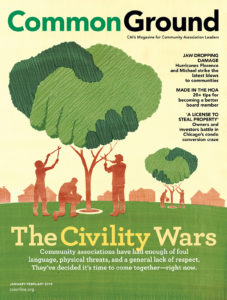
Read about these steps and a discussion about civility today in “A Civil Action,” the cover story in the January/February Common Ground TM magazine. 

For the article, we checked in with some experts on the subject, including Daniel Buccino, the current director of the Johns Hopkins Civility Project at Johns Hopkins University in Baltimore, Md.

Is strife becoming more common in American society? Public opinion polls show that most people believe that it is, yet Buccino notes that people have been concerned about civility for a long time, and many think it’s somebody else’s problem.

The university’s project was founded in 1997 by Pier Massimo Forni as an aggregation of academic and community outreach activities aimed at “assessing the significance of civility, manners and politeness in contemporary society.” Forni’s efforts inspired civility-based initiatives on college campuses and in communities around the country.

In his book Choosing Civility, published in 2003, Forni shares and examines 25 rules of considerate conduct. He writes about the need to be agreeable: “We need agreement in our lives because it is gratifying and healing, because human bonds could not be forged without it, and because it is the foundation of social harmony. Of course disagreement can be productive. ‘A little rebellion, now and then, is a good thing,’ observed Thomas Jefferson. In disagreement alone, however, we couldn’t survive.”

Sadly, like Bush, Forni also passed away at the end of 2018. As a new year begins, maybe we can learn to follow their advice. Maybe we can accept that incivility today is our problem. Maybe we all can be a little kinder, gentler, civil, and agreeable.

The post A ‘kinder, gentler’ community starts with you appeared first on Ungated: Community Associations Institute Blog.

BiggerPockets Podcast 313: How to Be Happy AND Grow a Massive Business with Entrepreneur Jesse Itzler (and Josh!)

You want to crush it in real estate investing. But you also want fun, adventure, and time for yourself and your loved ones. Can you have both? Our guest today says, “YES!”

Jesse Itzler is a serial entrepreneur who’s worn a lot of hats: rapper, founder of a private jet company (sold to Warren Buffett’s Berkshire Hathaway), partner in a coconut water venture (sold to Coca-Cola), ultra-marathoner, and part-owner of the Atlanta Hawks.

Jesse shares his plan for 4x-ing your productivity, what he learned from living with a Navy SEAL (and writing a book about it!), and why investors must learn to “fall in love with the process,” rather than the product. You’ll learn his trick for scheduling memorable experiences and why you should develop your own “happiness meter.”

Oh, and stick around to hear Jesse’s hilarious story about performing in front of 600,000 people—and forgetting the words. This show is packed with wise counsel for anyone who is or wants to be a hard-charging entrepreneur, but also craves more balance and bliss. Download this episode, and share it with a friend or family member who would enjoy it! When you do, tag us on Twitter (@jrdorkin, @brandtonatBP, @biggerpockets) or Instagram (@jrdorkin, @beardybrandon, @biggerpockets)!

What does a community association manager do?

Community associations today employ highly-qualified professional community association managers, and we think residents should know what the manager has—and has not—been hired to do.

Some residents expect the manager to perform certain tasks that just aren’t part of the job. When the manager doesn’t meet those expectations, residents are unhappy. In short, the manager has two primary responsibilities: Carry out policies set by the board and manage the association’s daily operations.

In practice, what does that mean for some common resident questions and concerns?

  • The manager is trained to deal with conflict, but he or she typically will not get involved in quarrels you might be having with your neighbor. However, if association rules are being violated, the manager is the right person to notify.
  • While the manager works closely with the board, he or she is an advisor—not a member of the board. Also, the manager is not your advocate with or conduit to the board. If you have a concern, send a letter or e-mail directly to the board.

  • Although the manager works for the board, he or she is available to residents. That doesn’t mean the manager will drop everything to take your call. If you need to see the manager, call and arrange a meeting.
  • The manager is always happy to answer questions, but he or she is not the information officer. For routine inquiries, like the date of the next meeting, read the newsletter or check the association website or bulletin board.
  • The manager is responsible for monitoring contractors’ performance but not supervising them. Contractors are responsible for supervising their own personnel. If you have a problem with a contractor, notify the manager, who will forward your concerns to the board. The board will decide how to proceed under the terms of the contract.
  • The manager inspects the community regularly but even an experienced manager won’t catch everything. Your help is essential. If you know about a potential maintenance issue, report it to the manager.
  • The manager does not set policy. If you disagree with a policy or rule, you’ll get better results sending a letter or e-mail to the board than arguing with the manager.
  • The manager has a broad range of expertise, but he or she is not a consultant to the residents. Neither is he or she typically an engineer, architect, attorney, or accountant. The manager may offer opinions but don’t expect technical advice in areas where he or she is not qualified.
  • Although the manager is a great resource to the association, he or she is not available 24 hours per day—except for emergencies. Getting locked out of your home may be an emergency to you, but it isn’t an association emergency. An association emergency is defined as a threat to life or property.

For more information on the community association manager’s role, visit www.caionline.org and search “community managers.”

The post What does a community association manager do? appeared first on Ungated: Community Associations Institute Blog.